
Start at Westminster Abbey at 9:30am when it opens. Spend two hours there. Then travel to St. Paul’s for the afternoon. That is the route. Everything else is detail — but the details matter a lot.
Ticket Prices and Booking: What You’ll Actually Pay
Westminster Abbey adult tickets cost £27. St. Paul’s Cathedral charges £23 for adults. Children under 6 are free at both. Together, that’s £50 per adult for a full day across both sites — budget accordingly before you arrive.
| Feature | Westminster Abbey | St. Paul’s Cathedral |
|---|---|---|
| Adult ticket | £27 | £23 |
| Child (6–17) | £12 | £10.50 |
| Under 6 | Free | Free |
| Opens (Mon–Sat) | 9:30am | 8:30am |
| Last entry (Mon–Sat) | 3:30pm | 4:30pm |
| Open to tourists on Sundays | No — services only | Limited access, galleries closed |
| Audio guide included | Yes, with ticket | Yes, multimedia guide included |
| Covered by London Pass | Yes | No |
Should You Book in Advance?
Yes. Westminster Abbey regularly sells out by 11am during July and August. St. Paul’s is slightly more forgiving for walk-ups, but the queue can reach 45 minutes on peak summer days. Book both directly through the official sites. Third-party resellers charge up to £5 extra per ticket with no added benefit — they are not worth it.
The Free Entry Exception
St. Paul’s has a small rear section — near the high altar — that is free to enter for prayer and quiet reflection. Paid tickets are required for the nave, crypt, galleries, and dome. Westminster Abbey has no equivalent free zone for tourists. Some London borough residents qualify for complimentary access on designated community days; check the Abbey’s official site if that applies to you.
How to Visit Both in One Day: Step-by-Step
This route works on any weekday. Do not attempt it on a Sunday — Westminster Abbey is closed to tourists entirely.
The Full Day Itinerary
- 8:45am — Arrive at Westminster, 45 minutes before opening. Pick up a coffee from the Costa Coffee on Victoria Street, a 3-minute walk from the Abbey entrance. You will be near the front of the queue when doors open.
- 9:30am–11:30am — Westminster Abbey. Use the included audio guide from the start. It routes you through Poets’ Corner, the Coronation Chair, and the Royal Tombs in the correct sequence. Skipping it means you will miss context that makes the whole visit click.
- 11:30am–12:00pm — Walk five minutes to Westminster tube station. Take the Circle or District Line to Blackfriars, then walk 10 minutes to St. Paul’s. Alternatively, take the Central Line from Bank to St. Paul’s — total journey time either way is around 20–25 minutes.
- 12:00pm–12:45pm — Lunch at the Crypt Café at St. Paul’s Cathedral. This is a real, full-service restaurant in the cathedral’s crypt, serving hot meals, sandwiches, and soups. Average spend is £12–16 per person. Unusual setting, genuinely good food, and it means you start your cathedral visit with energy rather than hunger.
- 12:45pm–3:30pm — St. Paul’s Cathedral. Budget a minimum of 2.5 hours if you want to do the full dome climb to the Golden Gallery (528 steps). The views from 85 metres above ground are the reason to come. Allow time for the crypt separately — it is not on the dome route.
Thames Boat as an Alternative Transfer
City Cruises runs passenger ferries between Westminster Pier and Blackfriars Pier. Journey time is roughly 25–30 minutes and adult fares are around £12 one-way. It is not the fastest option — the tube beats it by 10 minutes — but the river views of Waterloo Bridge, the Tate Modern, and the City skyline are a genuine bonus if you are not rushed. Buy tickets at the pier; no advance booking needed for this route.
St. Paul’s Cathedral: What’s Inside and How Long You Need
Christopher Wren designed the current cathedral after the Great Fire of London destroyed the medieval original in 1666. Construction finished in 1711, making it one of the few English cathedrals built within a single architect’s lifetime. Walking in from the west entrance, the scale is the first thing that registers — the nave runs 175 metres end to end, and the dome sits 111 metres above the floor.
The Whispering Gallery: 259 Steps
The first gallery runs around the inside of the dome, just above where the drum meets the base. Lean close to the wall and whisper — someone on the directly opposite side will hear it as if you are standing next to them. The geometry that causes it (a circular smooth stone surface redirecting sound waves) is the same principle as whispering galleries at Grand Central Terminal in New York and St. George’s Hall in Liverpool. It is not a gimmick. The climb to this level takes 15–20 minutes at a comfortable pace. Strollers and large bags cannot go beyond this point.
Stone Gallery and Golden Gallery: 378 and 528 Steps
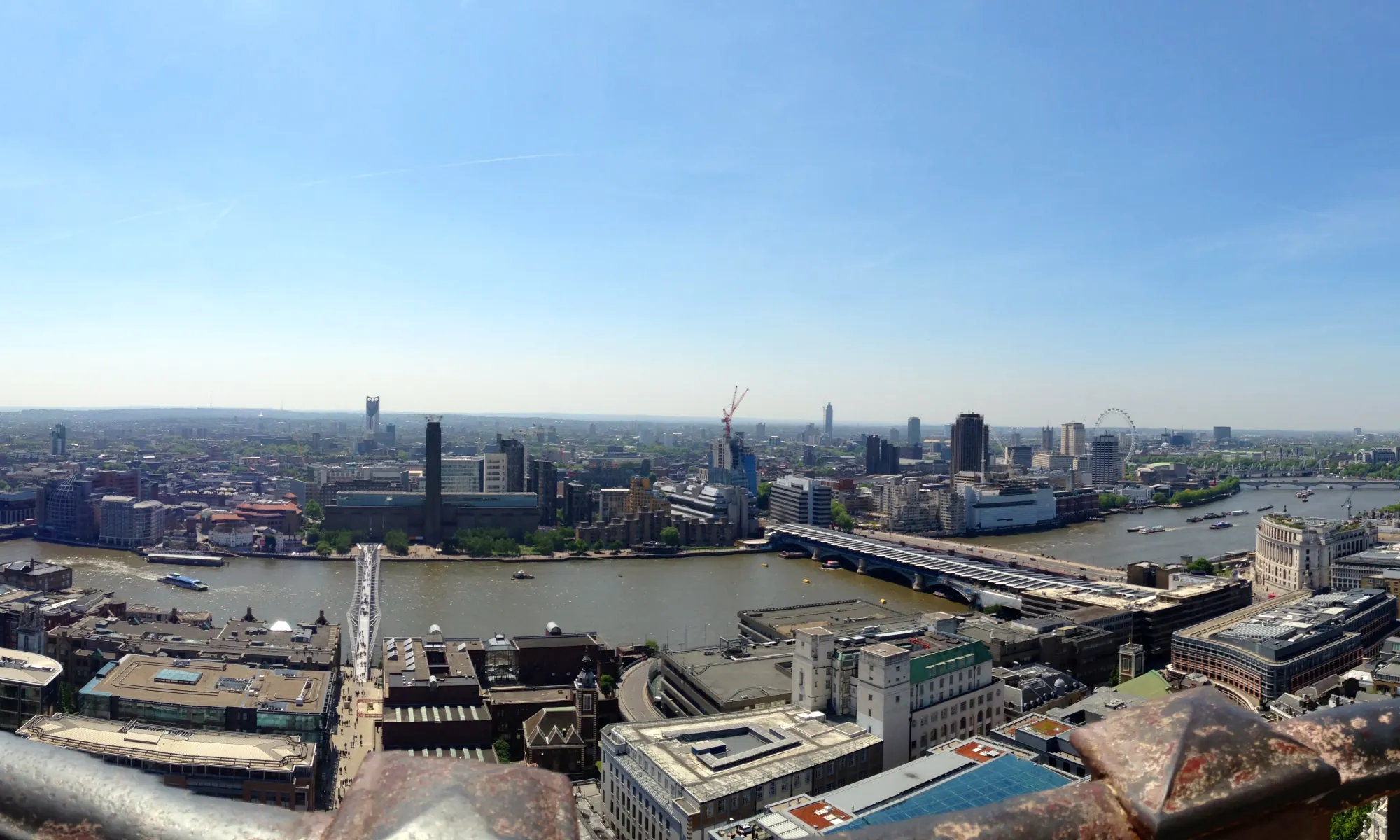
The Stone Gallery gives you the first outdoor panorama. It is good. Keep going. The Golden Gallery — the final 528 steps — puts you 85 metres above street level with unobstructed 360-degree views. To the east: Canary Wharf and the Olympic Park. To the south: the Tate Modern and the Shard. To the north: the BT Tower and the rolling spread of north London. On a clear day, visibility extends well beyond 20 miles.
The final 150 steps are narrow, steep, and enclosed. This is not a mild warning buried in the fine print. If you have serious vertigo, heart conditions, or limited mobility, the Whispering Gallery is the sensible stopping point. Everyone else: go up. The descent takes about 20 minutes.
The Crypt
The crypt holds the tombs of Admiral Lord Nelson and the Duke of Wellington — the two most significant military commanders in British history, sharing a floor. Nelson’s coffin is inside a black sarcophagus originally commissioned for Cardinal Wolsey in the 16th century. Wellington’s tomb is a plain red granite block weighing 27 tonnes, which is either appropriately austere or deeply anticlimactic depending on your expectations. The crypt also contains the tomb of Christopher Wren himself. His epitaph, carved into the floor above: Lector, si monumentum requiris, circumspice — Reader, if you seek his monument, look around you.
Plan 45 minutes for the crypt alone if you want to read the memorials properly. The Crypt Café is in the same space, which means the smell of lunch occasionally competes with 300-year-old stone. It is an odd but entirely functional combination.
Westminster Abbey: Highlights and What to Skip
Forty-two coronations. Seventeen monarchs buried here. Geoffrey Chaucer, Charles Dickens, Isaac Newton, Charles Darwin — all interred or memorialised within the same building. The density of historical significance is hard to process without the audio guide anchoring the context. Use it.
Poets’ Corner
The southeastern transept is the literary heart of the Abbey. Chaucer, who is actually buried here, started the tradition in 1400. Dickens, Hardy, and Kipling followed — also buried here. Shakespeare has a memorial but is buried in Stratford-upon-Avon. The floor itself is covered with inscribed memorial stones; you are walking over graves the entire time. Go slowly. Read the names. This is the section where most visitors stop rushing.
The Coronation Chair
Built around 1300 for Edward I, this oak chair has been used in every English and British coronation since 1308. It looks like weathered medieval furniture — because it is. Westminster School boys carved graffiti into the wood over centuries; it is visible up close. The Stone of Destiny — the ancient Scottish coronation stone, normally kept at Edinburgh Castle — is placed beneath the chair during coronation ceremonies. The most recent use was in May 2026 for the coronation of Charles III.
What You Can Skip on a First Visit
The Chapter House and the Abbey Museum are worthwhile on a second visit. On a first trip with limited time, skip both and spend the extra 20 minutes in the main church. The College Garden — a medieval walled garden behind the Abbey — is pleasant in good weather but rarely the reason anyone came to Westminster.
Five Mistakes That Waste Time and Money
Going on a Sunday is the biggest one. Westminster Abbey is closed to tourists on Sundays, full stop. No exceptions, no partial access. This surprises a meaningful number of visitors every week who did not check before booking travel.
- Skipping the dome climb at St. Paul’s because the queue looks long at ground level. The queue moves in under 20 minutes on most days. The view from the Golden Gallery is the single best free-ish panorama in central London.
- Underestimating time at Westminster Abbey. First-time visitors who budget 90 minutes leave feeling like they missed something — because they did. Minimum two hours. Two and a half if history is your reason for coming.
- Buying same-day tickets at the door in summer. Westminster Abbey sells out at the gate by midday during peak season. Same-day tickets are available online until they are gone, so book the night before at the very latest.
- Wrong footwear. St. Paul’s involves 528 steps on narrow stone spiral staircases. Westminster Abbey is mostly flat walking on uneven medieval flagstones that shift slightly underfoot. Neither is a place for new shoes or heels.
- Doing St. Paul’s first and Westminster Abbey second. St. Paul’s opens at 8:30am and Westminster Abbey at 9:30am. Starting at St. Paul’s wastes an hour standing outside the Abbey. Always start at Westminster.
London Pass vs. Individual Tickets: The Real Math
Buy individual tickets if your day is just these two sites. The London Pass does not include St. Paul’s Cathedral — and that changes the calculation completely for anyone planning a focused two-cathedral visit.
When the London Pass Saves Money
A 1-day London Pass costs approximately £79 per adult in 2026. It covers Westminster Abbey (£27 value), the Tower of London (£34.80), Kew Gardens (£22), Hampton Court Palace (£28.50), and roughly 80 other paid attractions. If your itinerary includes three or more London Pass attractions in a single day, the pass pays for itself. A 2-day pass runs around £99 and becomes highly cost-effective for anyone doing a proper sightseeing trip.
When Individual Tickets Win
If your London plan is Westminster Abbey plus St. Paul’s plus nothing else paid, buy separately. Combined cost: £50 per adult. The London Pass saves you nothing and still does not cover St. Paul’s, meaning you pay for the pass AND pay for St. Paul’s on top. That is a worse deal than just buying two tickets.
The verdict: London Pass only if you are hitting three or more included attractions. For a two-cathedral day, individual tickets are the right call — simpler, cheaper, and you skip the mental overhead of trying to squeeze enough value from the pass before it expires.
Both sites reward a slower pace than most visitors allow. The visitors who leave satisfied are almost always the ones who went in with a plan and resisted the urge to rush.